The Agentic Turn: Why 2026 Is the Year AI Stopped Waiting for Instructions
For a decade, humans prompted and AI responded. In 2026, autonomous AI agents are opening pull requests, running factory shifts, and conducting laboratory experiments without waiting for the next command.
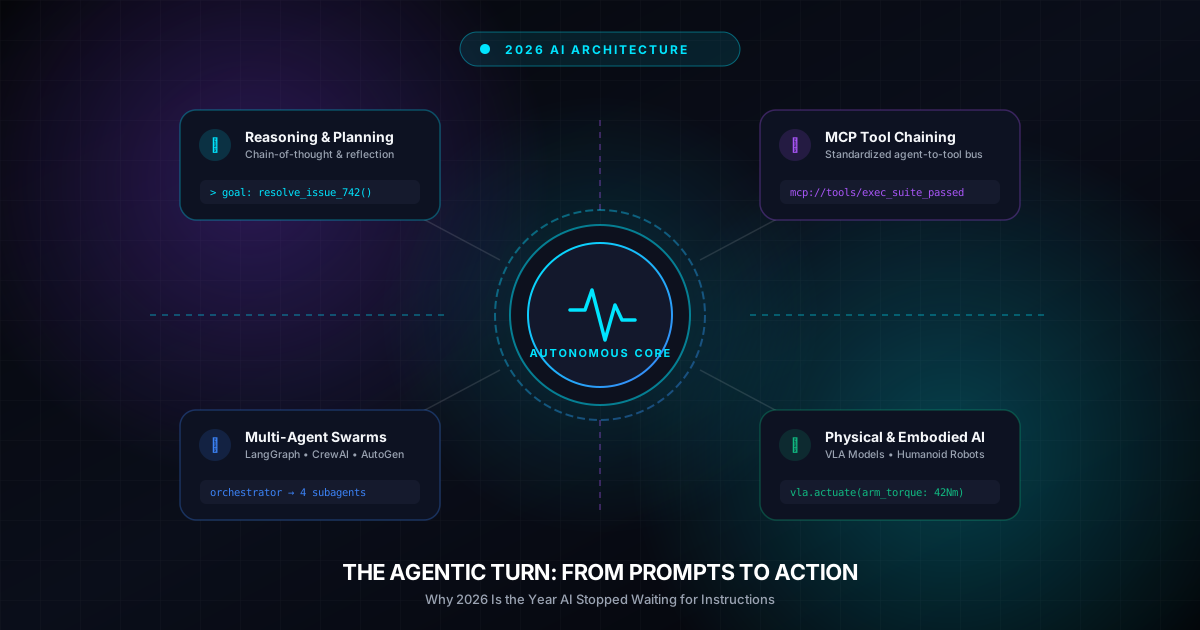
Explore the agentic turn in 2026: how autonomous AI agents evolved from prompt chatbots to proactive systems using MCP, multi-agent frameworks, and physical AI.
For most of the last decade, using AI meant a very specific ritual: type a question, wait for an answer, read it, then decide what to do next. The AI did the thinking. You did the acting. That division of labor held through the chatbot boom, through the copilot era, through a hundred "AI-powered" product launches that were really just a text box bolted onto existing software.
That ritual is breaking down. Right now, in production environments most people will never see, autonomous AI agents are opening pull requests, triaging security alerts, negotiating with other AI agents over shared tasks, and — increasingly — walking around factory floors. Nobody prompted them to do any of that in the moment. They decided to, based on a goal someone set hours or days earlier.
This is the agentic turn: the shift from AI that responds to AI that acts. And 2026 is shaping up to be the year it stopped being a research demo and became infrastructure.
This deep dive breaks down what is actually driving that shift — the protocols, architectures, and frameworks underneath the buzzwords — and where the next wave of AI inventions is headed, from your terminal to the factory floor to the research lab.
From Assistive AI to Autonomous Agents: How We Got Here
To understand why 2026 feels fundamentally different, it helps to see the last five years as one continuous handoff of operational responsibility from human to machine.
The Assistive Era (2020–2023)
This was the age of the copilot — AI as a very well-read intern. You asked, it answered. Every action still ran through a human clipboard: copy the code, paste it, run it yourself. The model had no memory between sessions and no ability to touch anything outside the chat window.
The Reasoning Breakthrough
Somewhere around 2023–2024, frontier models got noticeably better at breaking problems into steps before answering — techniques researchers call "chain-of-thought" and "reflection", where a model effectively drafts, critiques, and revises its own reasoning before responding. This mattered enormously, because acting autonomously requires more than static knowledge. It requires a resilient, multi-step plan.
The Tool-Use Inflection Point
Reasoning alone doesn't let an AI do anything. The real unlock came when models learned to call external functions — search the live web, query a database, execute code in a sandbox, and read file trees. This is the moment AI grew hands. A model that can reason and act stops being a search engine with better grammar and starts being an autonomous agent.
2025–2026: Agents Go Autonomous
Put reasoning and tool use together, give the system a longer leash — hours instead of seconds — and something qualitatively different emerges. Early coding agents in 2024 could fix a single bug in a few minutes. By 2026, agents are routinely producing entire production features over several hours, with minimal human checkpoints in between. That's not a faster version of the old workflow. It's a different workflow entirely — a genuine agentic workflow, where a human sets a high-level goal and a system plans, executes, checks its own work, and only surfaces the result (or a blocker) at the end.
Why Now, Specifically?
Three foundational trends converged almost simultaneously in 2026:
- Mega-Context Windows: Context windows expanded from thousands of tokens to millions, easily holding entire repositories and long multi-turn execution histories.
- Standardized Tool Interfaces: Open protocols replaced brittle, one-off vendor integrations with universal standards.
- Production Orchestration Frameworks: Multi-agent state engines matured from academic toys into hardened enterprise platforms.
What Actually Makes an AI "Agentic"?
The word "agentic" gets thrown around loosely in marketing decks, so it's critical to establish a precise technical baseline.
Agentic AI is not the same as generative AI, and it is not traditional robotic process automation (RPA):
| Dimension | Generative AI | Traditional RPA | Agentic AI (2026) |
|---|---|---|---|
| Core Function | Produces content on request | Executes fixed, pre-scripted steps | Pursues a goal, adapting its own steps dynamically |
| Adaptability | None between isolated requests | Zero — breaks immediately if UI or API shifts | High — replans and recovers when conditions change |
| Initiative | Waits passively to be prompted | Waits for pre-configured triggers | Decides the next operational action autonomously |
| Error Handling | Blind output generation | Throws unhandled fatal exceptions | Inspects errors, reflects, and applies self-correction |
The common thread in every genuinely agentic system is a continuous closed loop: perceive → plan → act → observe → adapt. The agent inspects the current state of the world — a codebase, an inbox, a cloud cluster, or a warehouse floor — formulates a plan, invokes a tool, verifies whether the output matches expectations, and adjusts its course.
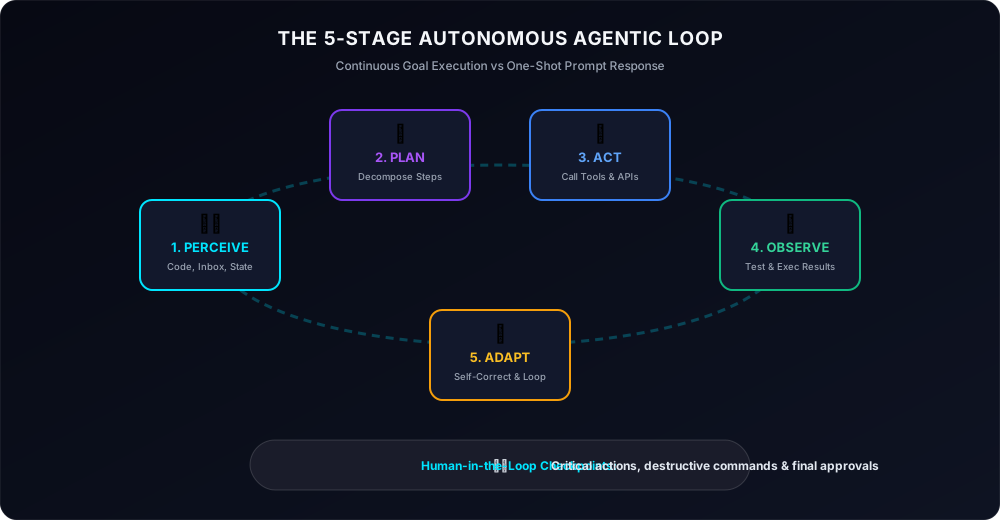
Underneath that loop, most autonomous AI agents share five core architectural building blocks:
- Memory: Short-term working context (current task trajectory) combined with long-term episodic and semantic memory that survives across sessions.
- Planning: Hierarchical task decomposition that transforms vague goals into verified directed acyclic graphs (DAGs).
- Tool/Function Calling: Structured interfaces granting the agent the capability to interact with external APIs, databases, terminals, and web browsers.
- Self-Correction: Internal reflection loops that run compilers, test suites, and linters to catch mistakes before surfacing code to humans.
- Human-in-the-Loop Checkpoints: Deliberately architected pause points where a person reviews and signs off on high-stakes, costly, or irreversible actions.
The best agentic systems aren't the ones with zero human involvement — they are the ones that know exactly which decisions need human judgment and which can run safely on autopilot.
Tool Use: Giving AI Hands to Act on the World
If reasoning is the brain of an agentic system, tool use is the hands. Technically, it works through function calling: developers describe available capabilities in a structured JSON schema, and the model chooses to emit an invocation payload rather than plaintext.
The monumental leap in 2026 wasn't a single isolated tool call — it was autonomous tool chaining. A modern coding agent doesn't stop after reading a file; it chains 6 to 10 distinct operations in sequence:
- Reads the broken source file and relevant unit tests
- Spawns a terminal sub-process to run the test suite and captures stack traces
- Performs a semantic codebase search to identify all dependent modules
- Edits the source code using precise replacement hunks
- Re-runs the test suite to verify whether the regression is resolved
- Commits the fix to a feature branch and opens a GitHub pull request
Think of the difference this way: a single tool call is handing someone a hammer. Tool chaining is handing them a toolbox, letting them notice a bent nail, put the hammer down, pick up pliers to straighten it, and then pick the hammer back up — completely unprompted.
Model Context Protocol (MCP): The "USB-C for AI"
Until recently, the single largest bottleneck in agentic adoption was integration friction. Every time an engineering team wanted an AI agent to interface with a new internal tool — Slack, GitHub, Jira, PostgreSQL, or Kubernetes — they had to write brittle, bespoke glue code for that specific vendor pairing.
Model Context Protocol (MCP), originally introduced by Anthropic and rapidly adopted as an open industry standard, solves this the same way USB-C solved peripheral cables: one standard interface instead of dozens of incompatible adapters.
How MCP Works
An MCP server exposes data sources, prompts, and callable tools through a standardized RPC interface. Any compliant MCP client (the AI agent or IDE) can dynamically discover available servers, inspect capabilities, and invoke them safely without developers authoring custom integration code for every permutation.
In 2026, building one MCP server for your company's internal platform makes it instantly accessible across Claude, Cursor, Antigravity, ChatGPT, and custom internal multi-agent swarms alike.
Multi-Agent Systems: When One Agent Isn't Enough
A single monolithic agent, no matter how powerful, inevitably degrades on complex, multi-domain initiatives. Just as an enterprise engineering organization divides responsibilities among specialists, modern architectures leverage Multi-Agent Systems (MAS).
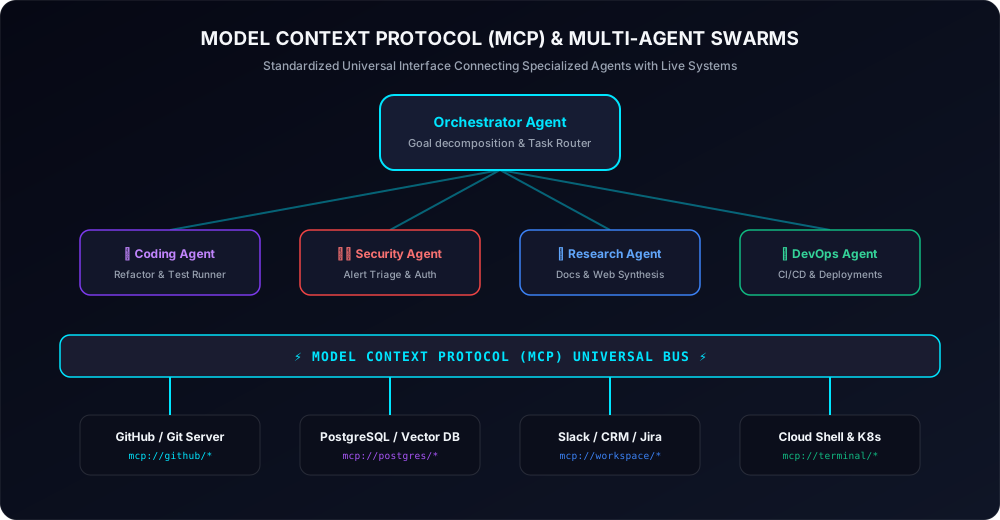
Common Multi-Agent Architectures
- Orchestrator–Worker (Hub-and-Spoke): A central orchestrator agent evaluates the high-level directive, decomposes it into discrete subtasks, dispatches them to specialized worker agents (coder, security auditor, tester), and compiles the final deliverable.
- Peer-to-Peer Negotiation: Autonomous agents communicate directly via structured protocols, negotiating resource allocation and task ownership without a single point of failure.
- Hierarchical Manager–Subagent Trees: Multi-tiered organizational structures where managerial agents supervise sub-crews, mimicking human engineering hierarchies.
The 2026 Framework Ecosystem
Five leading frameworks have solidified as production infrastructure for multi-agent applications:
- LangGraph: Graph-based state machine framework ideal for complex, cyclical, and branching agent logic with strict human-in-the-loop controls.
- CrewAI: Role-based agent orchestration where developers define agents with distinct personas, goals, and team collaboration dynamics.
- OpenAI Agents SDK: Streamlined, lightweight framework engineered for ultra-fast handoffs between specialized agents.
- Microsoft AutoGen: Conversational multi-agent patterns enabling agent swarms to solve problems through multi-party dialogue.
- Claude Agent SDK: Long-horizon execution patterns built specifically around robust tool chaining and subagent delegation.
Physical AI and Humanoid Robots: Agentic AI Gets a Body
While software agents manipulate codebases and databases, Physical AI represents the frontier where agentic reasoning gains physical embodiment — operating in factories, logistics hubs, and physical assembly lines.
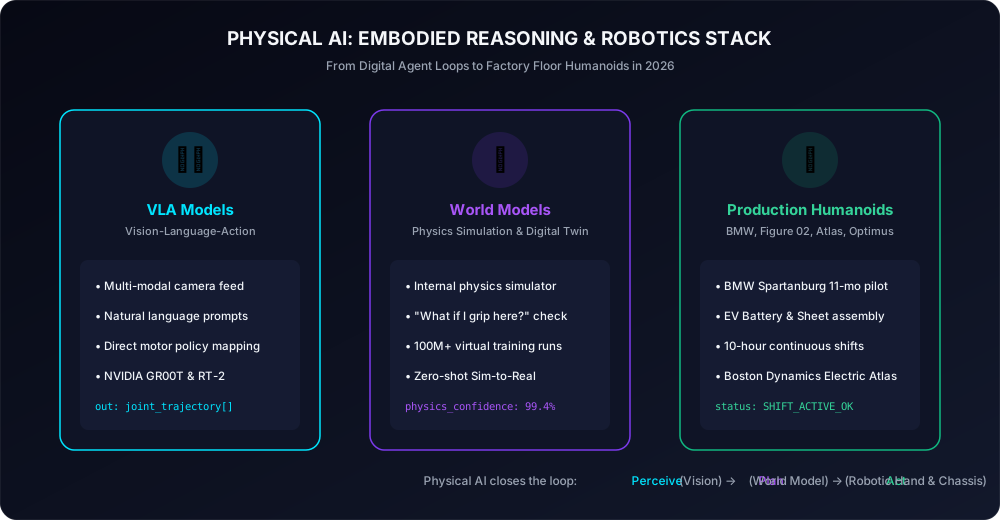
The Embodied Tech Stack
- Vision-Language-Action (VLA) Models: Foundation models that ingest real-time RGB-D camera feeds and audio commands, outputting continuous low-level motor torque trajectories without manual kinematic programming.
- World Models & Physics Simulation: Internal predictive simulation engines allowing robots to calculate "If I apply 35Nm of grip force here, will the sheet metal deform?" before committing physical actions.
- Sim-to-Real Transfer: Digital twin platforms (such as NVIDIA Isaac Sim and Omniverse) training agents across hundreds of millions of virtual hours prior to physical deployment.
Real-World Factory Deployments
At BMW's Spartanburg assembly plant in South Carolina, two Figure AI humanoid robots completed real assembly-line shifts — ten hours a day, five days a week — for eleven consecutive months handling sheet-metal insertion and subassembly placement. BMW has now expanded the program to its German EV battery facility. Concurrently, NVIDIA's open GR00T foundation models, Tesla's Optimus Gen 3, and Boston Dynamics' fully electric Atlas are shifting robotics from pre-programmed repetition to adaptive physical problem-solving.
AI in Scientific Discovery: Agents as Co-Researchers
Science is arguably the purest domain for the agentic paradigm. The classical scientific method — Hypothesize → Experiment → Observe → Refine — directly mirrors the autonomous perceive-plan-act loop.

In 2026, scientific agents are driving breakthroughs across three vectors:
- Autonomous Hypothesis Generation: Literature ingestion engines cross-referencing tens of thousands of papers across disparate domains to discover unnoticed molecular connections.
- Self-Driving Wet Laboratories: Closed-loop robotic systems where AI designs molecular assays, commands automated liquid handlers and spectrometers, analyzes results, and iterates 24 hours a day.
- High-Throughput Material & Drug Design: Expanding on AlphaFold milestones, agents screen combinatorial chemical spaces of billions of candidates, compressing R&D timelines from years into weeks.
The Risks and Open Questions Nobody Should Skip
The transition to agentic autonomy introduces complex operational challenges that engineering leaders must address:
- Compounded Failure Rates: A single subagent operating at 95% accuracy chained across ten sequential steps yields an aggregate success rate of only
(0.95)^10 ≈ 59.8%. System resilience requires robust intermediate assertion checks. - Prompt Injection & Tool Hijacking: Agents with broad tool permissions risk being tricked into unauthorized data exfiltration or destructive commands via malicious indirect inputs (e.g. malicious code comments or emails).
- Governance and Liability: When an autonomous trading agent or support agent causes financial harm, legal liability spans the deployment enterprise, the model provider, and the orchestration framework.
- Verifiability: Autonomous workflows require transparent telemetry, immutable audit logs, and replayable execution traces.
How to Prepare: Actionable Takeaways
🛠️ For Software Engineers
- • Master at least one multi-agent orchestration framework (LangGraph, CrewAI, or Claude Agent SDK).
- • Standardize internal tool connections using Model Context Protocol (MCP).
- • Build resilient error handling, retry limits, and sandboxed test runners into every agent tool.
💼 For Business Leaders
- • Begin with narrow, well-bounded workflows before granting agents autonomous financial or customer authority.
- • Establish strict least-privilege API scopes and immutable action audit logs.
- • Train teams for the emerging "Agent Orchestrator" role rather than relying on legacy prompt engineering.
The Bottom Line
The most consequential technological breakthrough of 2026 is not simply a model with more parameters. It is the emergence of closed-loop, self-correcting systems that plan, act, verify, and adapt. Software experienced this shift first. Robotics is demonstrating it on manufacturing floors today. Science is scaling it next.
The instructions haven't disappeared — but artificial intelligence has, decisively, stopped waiting for someone to type the next prompt before taking action.
Ava Mitchell
Editorial writer and AI researcher at MonsterAITools.
Frequently Asked Questions
What is the 'Agentic Turn' in AI?+
The Agentic Turn describes the paradigm shift from passive, prompt-and-response AI models (chatbots, copilots) to proactive autonomous agents that receive a high-level goal and independently plan, call tools, execute multi-step workflows, and self-correct over hours without continuous human intervention.
How does Model Context Protocol (MCP) work?+
Model Context Protocol (MCP) is an open standard that connects AI agents to external tools and data repositories (like GitHub, PostgreSQL, Slack, and terminal environments). It acts like a universal 'USB-C for AI', eliminating the need for custom, proprietary integrations for every tool-model pair.
What is the difference between Agentic AI and Robotic Process Automation (RPA)?+
Traditional RPA follows rigid, pre-scripted rules and breaks whenever an interface or schema changes. Agentic AI is goal-driven, understands natural language, reasons about edge cases, and dynamically adapts its execution plan when encountering unexpected errors or system states.
How are humanoid robots using Physical AI in 2026?+
Humanoid robots like Figure 02, Tesla Optimus, and Boston Dynamics Electric Atlas combine Vision-Language-Action (VLA) foundation models with real-time world simulation physics to perceive unstructured environments, manipulate industrial parts, and work multi-hour factory shifts without pre-programmed paths.
What are the primary security risks of autonomous AI agents?+
Key risks include indirect prompt injection attacks, unauthorized tool execution, compounded failure rates across multi-agent handoffs, and credential exposure. Enterprise systems mitigate this through least-privilege scoped permissions, sandboxed environments, and human-in-the-loop approval checkpoints for critical operations.
Related AI Guides
Continue exploring deeper insights in Industry News.
A Complete Guide to AI Image Upscaling Tools
A Complete Guide to AI Image Upscaling Tools — what we found after actually testing this, not just skimming the marketing page.
Top AI Tools for Social Media Managers
Top AI Tools for Social Media Managers: pricing, real trade-offs, and whether it's worth your time in 2026.
Latest AI News Roundup This Week
An honest, hands-on look at latest ai news roundup this week, including the parts most reviews leave out.