AI Trends 2026: What's Next for Generative AI
An honest, hands-on look at ai trends 2026, including the parts most reviews leave out.

AI Trends 2026: What's Next for Generative AI. Hands-on breakdown with honest pros, cons and pricing — updated for 2026.
There's a reason this keeps coming up in conversations with our readers. Today we're digging into AI Trends 2026, and by the end you should have a clear answer either way.
If you only read one paragraph, make it this one — everything below builds on the same core recommendation, just with more evidence.
Who Should (and Shouldn't) Bother
We'd rather recommend fewer tools we've actually tested properly than a long list scraped from other people's articles. None of this is a dealbreaker by itself — it's more about setting realistic expectations from day one.
We keep coming back to the same conclusion: the fundamentals (clear goals, good inputs, human review) matter more than which specific tool you pick. We'd rather flag it now than have you discover it three months into a contract.
A surprising number of "AI breakthroughs" in the headlines turn out to be incremental updates dressed up for a press cycle — worth staying skeptical.
The gap between what's technically possible and what's actually useful in a normal workday is bigger than most coverage admits.
Before you commit, run through this quick checklist:
- Cross-check any factual claims before publishing or acting on them
- Look at the tool's update history to judge how actively it's maintained
- Read a handful of independent reviews, not just the vendor's case studies
Pricing, Honestly Broken Down
It's easy to get swept up in the hype cycle here, but the practical questions — cost, reliability, what happens when it's wrong — matter more day to day. That's not a dealbreaker on its own, just something worth planning around before you commit budget.
There's a healthy amount of debate on this even among people who use these tools daily — don't expect total consensus. It won't matter for every team, but if it applies to yours, it's worth weighing heavily.
The people getting the most value tend to be the ones who set a narrow, specific goal instead of trying to "use AI" broadly. Worth flagging early, because it's the kind of thing that only shows up after the free trial ends.
It's worth remembering that most of these tools are still young products — expect rough edges, occasional downtime, and features that move around. Your mileage may vary depending on team size, but the pattern holds up across most of the cases we looked at.

What's Next for This Space
Reading the changelog is more useful than reading the landing page if you want to know whether a tool is actively improving. None of this is a dealbreaker by itself — it's more about setting realistic expectations from day one.
A lot of the loudest opinions online come from people who tried something once, three product updates ago. Recency matters a lot here. Most reviews gloss over this part, which is exactly why it's worth spelling out here.
Every few months something ships that genuinely changes the conversation, and every few months something else gets massively overhyped. Both are true at once. Worth flagging early, because it's the kind of thing that only shows up after the free trial ends.
| Tool | Pricing | Rating | Details |
|---|---|---|---|
| Beautiful.ai | Paid | ⭐⭐⭐⭐ 4.3 | View Tool |
| Runway | Freemium | ⭐⭐⭐⭐⭐ 4.9 | View Tool |
| Uizard | Freemium | ⭐⭐⭐⭐⭐ 5.0 | View Tool |
| Bolt.new | Freemium | ⭐⭐⭐⭐ 4.4 | View Tool |
Where the Competition Falls Short
We keep coming back to the same conclusion: the fundamentals (clear goals, good inputs, human review) matter more than which specific tool you pick. This is the kind of thing that separates a tool you try once from one you actually keep paying for.
A surprising number of "AI breakthroughs" in the headlines turn out to be incremental updates dressed up for a press cycle — worth staying skeptical. We'd rather flag it now than have you discover it three months into a contract.
The gap between what's technically possible and what's actually useful in a normal workday is bigger than most coverage admits. Worth flagging early, because it's the kind of thing that only shows up after the free trial ends.
How We Tested This
There's a healthy amount of debate on this even among people who use these tools daily — don't expect total consensus. It won't matter for every team, but if it applies to yours, it's worth weighing heavily.
The people getting the most value tend to be the ones who set a narrow, specific goal instead of trying to "use AI" broadly. This is the kind of thing that separates a tool you try once from one you actually keep paying for.
It's worth remembering that most of these tools are still young products — expect rough edges, occasional downtime, and features that move around.
Where This Actually Helps
A lot of the loudest opinions online come from people who tried something once, three product updates ago. Recency matters a lot here. Your mileage may vary depending on team size, but the pattern holds up across most of the cases we looked at.
Every few months something ships that genuinely changes the conversation, and every few months something else gets massively overhyped. Both are true at once. None of this is a dealbreaker by itself — it's more about setting realistic expectations from day one.
We try to separate the marketing claims from what actually happened in our own testing, and the two don't always line up. It's a small detail on paper, but it adds up once you're relying on the tool every single day.
- Beautiful.ai — Beautiful.ai helps you real-time collaboration and brand kit support using powerful AI — built for presentation.
- Runway — Runway helps you green-screen removal and 4k export using powerful AI — built for video.
- Uizard — Uizard helps you vector asset creation and ai layout suggestions using powerful AI — built for design.
- Bolt.new — Bolt.new helps you automated bug detection and multi-file context awareness using powerful AI — built for coding.
What to Watch Out For
A surprising number of "AI breakthroughs" in the headlines turn out to be incremental updates dressed up for a press cycle — worth staying skeptical. Most reviews gloss over this part, which is exactly why it's worth spelling out here.
The gap between what's technically possible and what's actually useful in a normal workday is bigger than most coverage admits. We'd rather flag it now than have you discover it three months into a contract.
What surprised us most during research wasn't the technology itself, it was how differently teams end up using the exact same tool. That alone isn't a reason to avoid it, but it's a reasonable reason to test before you buy annually.
It's easy to get swept up in the hype cycle here, but the practical questions — cost, reliability, what happens when it's wrong — matter more day to day. This is the kind of thing that separates a tool you try once from one you actually keep paying for.
"If a tool needs a two-hour onboarding call before anyone touches it, that's a signal worth paying attention to."
Final Thoughts
Test it on your next campaign with a small budget before committing further. That's the advice I give every client who asks.
Nothing here is set in stone; these tools update constantly. Check our directory listing for the most current pricing before you commit.
Priya Sharma
Priya specializes in AI writing and SEO tools, helping marketers build content engines that rank.
Frequently Asked Questions
Do you get paid to recommend any of these?+
Some links on this page are affiliate links, which is disclosed sitewide. It doesn't change our rankings — we've turned down sponsorships for tools we didn't rate highly.
Are these tools actually free, or is that misleading?+
Most of what we mentioned, including Beautiful.ai, Runway, Uizard, has a genuine free tier — not just a 7-day trial dressed up as "free." Paid plans mainly unlock higher usage limits and team features.
Is there a catch with the free plans?+
Usually just usage caps or watermarks rather than anything sneaky. Read the plan comparison page on the vendor's site before assuming a free tier covers your use case long-term.
How often do you update this list?+
We revisit articles like this every few months since pricing and features shift constantly in this space. If something here looks outdated, drop us a note through the Contact page.
Related AI Guides
Continue exploring deeper insights in AI News.
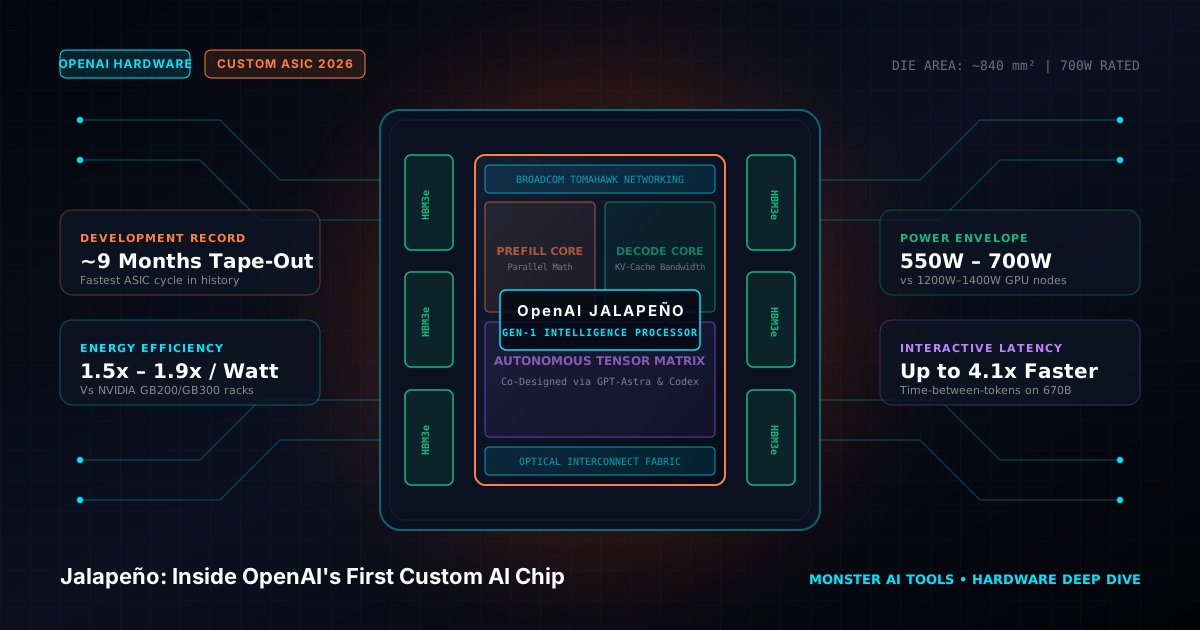
Jalapeño: Inside OpenAI's First Custom AI Chip
OpenAI and Broadcom have pulled the wrapper off Jalapeño — OpenAI's first purpose-built ASIC 'Intelligence Processor' for LLM inference. Here is how it was built in 9 months, how it solves the prefill/decode bottleneck, and its benchmark gains.

DeepSeek-R1 vs Claude 3.7 Sonnet vs OpenAI o3: The Ultimate 2026 Reasoning Benchmark
A comprehensive, technical breakdown of test-time compute, reasoning tokens, and coding benchmarks between DeepSeek-R1, Claude 3.7 Sonnet, and OpenAI o3.

AI Research Assistants: Perplexity and Beyond
An honest, hands-on look at ai research assistants, including the parts most reviews leave out.