DeepSeek-R1 vs Claude 3.7 Sonnet vs OpenAI o3: The Ultimate 2026 Reasoning Benchmark
A comprehensive, technical breakdown of test-time compute, reasoning tokens, and coding benchmarks between DeepSeek-R1, Claude 3.7 Sonnet, and OpenAI o3.

DeepSeek-R1 vs Claude 3.7 Sonnet vs OpenAI o3 compared. Benchmark scores, token pricing ($0.55 vs $15), test-time compute, and local hosting in 2026.
The artificial intelligence landscape in 2026 has undergone a fundamental architectural transformation. We have officially moved past the era of pure pre-training scaling laws into the frontier of Test-Time Compute and Inference-Time Reasoning.
Instead of merely guessing the next token instantaneously, modern frontier models allocate computational cycles during inference—generating internal chain-of-thought tokens, hypothesizing multiple solution branches, evaluating edge cases, and self-correcting before providing a definitive answer.
The Three Titans: Architectural Overview
Three models currently lead the global reasoning frontier:
- DeepSeek-R1 (Open-Weights): Trained using large-scale reinforcement learning (RL) without supervised fine-tuning warmups. Delivers parity with top proprietary models at a staggering 95% lower API cost ($0.55 per million input tokens).
- Claude 3.7 Sonnet (Anthropic): The industry's first hybrid reasoning architecture, allowing developers to dynamically adjust the thinking budget from 0 to 128,000 tokens while producing clean code artifacts.
- OpenAI o3 (OpenAI): The flagship reasoning powerhouse engineered for advanced mathematical proofs, complex multi-file engineering, and competitive programming benchmarks.
Head-to-Head Benchmark Scores
Here is how the three frontier models compare across standardized coding, mathematics, and graduate-level reasoning benchmarks:
| Benchmark | DeepSeek-R1 | Claude 3.7 Sonnet | OpenAI o3 |
|---|---|---|---|
| SWE-bench Verified (Coding) | 49.2% | 70.3% | 71.7% |
| AIME 2024 (Olympiad Math) | 79.8% | 80.5% | 87.7% |
| GPQA Diamond (PhD Science) | 71.5% | 78.4% | 82.1% |
| MATH-500 | 97.3% | 96.2% | 98.4% |
| API Pricing (1M Input) | $0.55 | $3.00 | $15.00 |
| Local / Self-Hostable | ✅ Yes (Ollama / vLLM) | ❌ Cloud API Only | ❌ Cloud API Only |
The Cost Efficiency Revolution
The most shocking breakthrough is the economics of reasoning. DeepSeek has demonstrated that open-weights reinforcement learning can produce near-frontier reasoning at a fraction of Western frontier API costs. For enterprise startups building high-throughput agent loops, running thousands of test iterations daily on DeepSeek-R1 saves tens of thousands of dollars per month compared to proprietary alternatives.
When to Use Which Model: The Decision Matrix
- Choose DeepSeek-R1: If you need cost-effective high-volume batch processing, local on-premise data privacy, or custom self-hosted pipelines via Ollama or vLLM.
- Choose Claude 3.7 Sonnet: If you are building full-stack applications with Claude Code, need nuanced human-like prose, or require dynamic control over thinking token budgets.
- Choose OpenAI o3: If you are solving hardcore mathematical optimization, novel scientific research, or zero-tolerance mission-critical algorithmic challenges.
Editorial Team
Editorial AI researcher and benchmark specialist at MonsterAITools.
Frequently Asked Questions
What is test-time compute in AI reasoning models?+
Test-time compute allows an AI model to spend extra computational time 'thinking' and exploring alternative reasoning paths before returning its final answer, dramatically increasing accuracy on complex math and coding tasks.
Can I run DeepSeek-R1 locally on my own PC?+
Yes. DeepSeek-R1 weights are open source, and quantized distilled versions (1.5B, 7B, 14B, 32B, 70B) can run locally on consumer GPUs and Apple Silicon using Ollama, LM Studio, or vLLM.
How does Claude 3.7 Sonnet hybrid thinking work?+
Claude 3.7 Sonnet allows you to set a 'thinking budget' (e.g. 2,000 tokens for simple tasks vs 32,000 tokens for complex architectural refactoring), giving you complete control over speed vs depth of reasoning.
Related AI Guides
Continue exploring deeper insights in AI News.
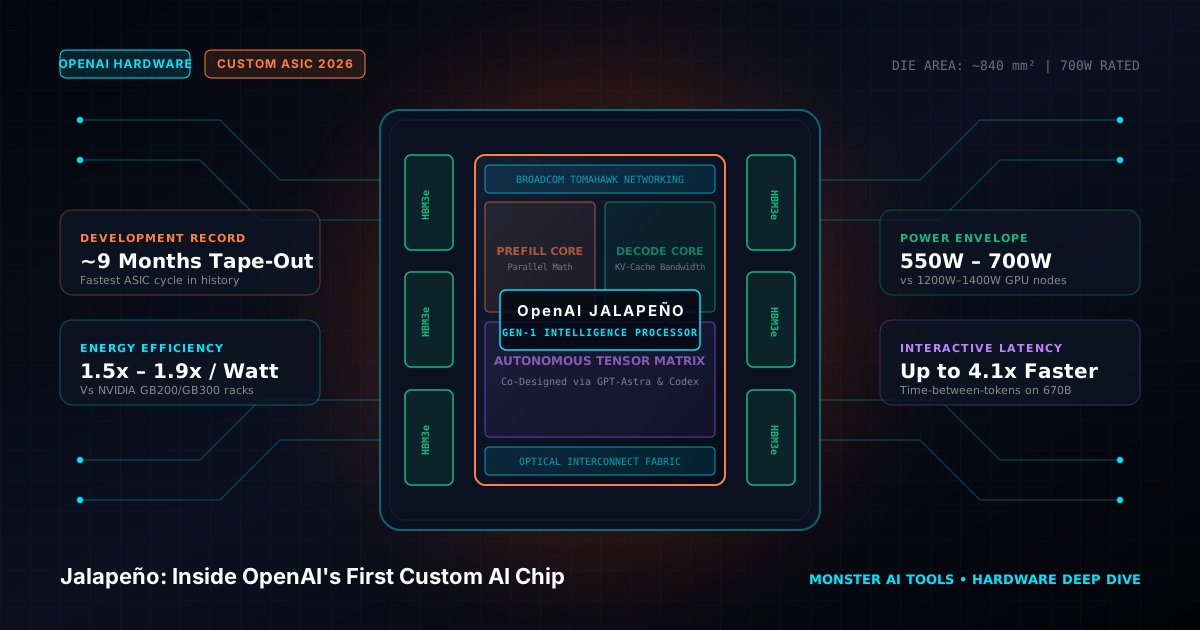
Jalapeño: Inside OpenAI's First Custom AI Chip
OpenAI and Broadcom have pulled the wrapper off Jalapeño — OpenAI's first purpose-built ASIC 'Intelligence Processor' for LLM inference. Here is how it was built in 9 months, how it solves the prefill/decode bottleneck, and its benchmark gains.

AI Research Assistants: Perplexity and Beyond
An honest, hands-on look at ai research assistants, including the parts most reviews leave out.

AI Trends 2026: What's Next for Generative AI
An honest, hands-on look at ai trends 2026, including the parts most reviews leave out.