Best AI Tools for Students in 2026
An honest, hands-on look at best ai tools for students in 2026, including the parts most reviews leave out.
Best AI Tools for Students in 2026. Hands-on breakdown with honest pros, cons and pricing — updated for 2026.
Most coverage on this topic reads like a press release. We're going to try not to do that. Today we're digging into Best AI Tools for Students in 2026, and by the end you should have a clear answer either way.
Quick answer if you're short on time: we'll walk through what actually matters, back it up with real pricing and ratings, and flag anything that tripped us up along the way.
Real-World Results
The gap between what's technically possible and what's actually useful in a normal workday is bigger than most coverage admits. That's not a dealbreaker on its own, just something worth planning around before you commit budget.
We try to separate the marketing claims from what actually happened in our own testing, and the two don't always line up.
Reading the changelog is more useful than reading the landing page if you want to know whether a tool is actively improving. That alone isn't a reason to avoid it, but it's a reasonable reason to test before you buy annually.
It's easy to get swept up in the hype cycle here, but the practical questions — cost, reliability, what happens when it's wrong — matter more day to day. It's a reasonable trade-off in our opinion, though not everyone will see it that way.
Before you commit, run through this quick checklist:
- Cross-check any factual claims before publishing or acting on them
- Look at the tool's update history to judge how actively it's maintained
- Read a handful of independent reviews, not just the vendor's case studies
Where This Actually Helps
We'd rather recommend fewer tools we've actually tested properly than a long list scraped from other people's articles. It's a reasonable trade-off in our opinion, though not everyone will see it that way.
The people getting the most value tend to be the ones who set a narrow, specific goal instead of trying to "use AI" broadly.
Every few months something ships that genuinely changes the conversation, and every few months something else gets massively overhyped. Both are true at once. This is the kind of thing that separates a tool you try once from one you actually keep paying for.
It's worth remembering that most of these tools are still young products — expect rough edges, occasional downtime, and features that move around. It's a small detail on paper, but it adds up once you're relying on the tool every single day.

Common Mistakes to Avoid
A surprising number of "AI breakthroughs" in the headlines turn out to be incremental updates dressed up for a press cycle — worth staying skeptical. It's a small detail on paper, but it adds up once you're relying on the tool every single day.
There's a healthy amount of debate on this even among people who use these tools daily — don't expect total consensus. This is the kind of thing that separates a tool you try once from one you actually keep paying for.
We keep coming back to the same conclusion: the fundamentals (clear goals, good inputs, human review) matter more than which specific tool you pick. We'd rather flag it now than have you discover it three months into a contract.
A lot of the loudest opinions online come from people who tried something once, three product updates ago. Recency matters a lot here.
The Setup Process
We try to separate the marketing claims from what actually happened in our own testing, and the two don't always line up. Your mileage may vary depending on team size, but the pattern holds up across most of the cases we looked at.
Reading the changelog is more useful than reading the landing page if you want to know whether a tool is actively improving. Worth flagging early, because it's the kind of thing that only shows up after the free trial ends.
It's easy to get swept up in the hype cycle here, but the practical questions — cost, reliability, what happens when it's wrong — matter more day to day.
What Changed Recently
The people getting the most value tend to be the ones who set a narrow, specific goal instead of trying to "use AI" broadly. This is the kind of thing that separates a tool you try once from one you actually keep paying for.
Every few months something ships that genuinely changes the conversation, and every few months something else gets massively overhyped. Both are true at once. Your mileage may vary depending on team size, but the pattern holds up across most of the cases we looked at.
It's worth remembering that most of these tools are still young products — expect rough edges, occasional downtime, and features that move around.
A Quick Comparison
There's a healthy amount of debate on this even among people who use these tools daily — don't expect total consensus. It's a small detail on paper, but it adds up once you're relying on the tool every single day.
We keep coming back to the same conclusion: the fundamentals (clear goals, good inputs, human review) matter more than which specific tool you pick. Most reviews gloss over this part, which is exactly why it's worth spelling out here.
A lot of the loudest opinions online come from people who tried something once, three product updates ago. Recency matters a lot here. It's easy to miss this in a five-minute demo, but it becomes obvious within the first real week of use.
The gap between what's technically possible and what's actually useful in a normal workday is bigger than most coverage admits. That's not a dealbreaker on its own, just something worth planning around before you commit budget.
Final Thoughts
Our recommendation, after weighing the numbers above, leans toward starting small and scaling up once you see results.
As always, take our word as a starting point, not gospel — your workflow might reward a different pick than the one we'd choose.
Ava Mitchell
Ava covers the AI tools landscape full-time, testing over 200 apps a year to help readers pick the right stack.
Frequently Asked Questions
What's the best option covered here?+
Based on hands-on testing, the top pick we covered came out ahead for most use cases we tried — though the right pick really depends on your budget and workflow. Don't just take our word for it; most of these offer free trials.
Is there a catch with the free plans?+
Usually just usage caps or watermarks rather than anything sneaky. Read the plan comparison page on the vendor's site before assuming a free tier covers your use case long-term.
How often do you update this list?+
We revisit articles like this every few months since pricing and features shift constantly in this space. If something here looks outdated, drop us a note through the Contact page.
Are these tools actually free, or is that misleading?+
Most of what we mentioned, including these tools, has a genuine free tier — not just a 7-day trial dressed up as "free." Paid plans mainly unlock higher usage limits and team features.
Do you get paid to recommend any of these?+
Some links on this page are affiliate links, which is disclosed sitewide. It doesn't change our rankings — we've turned down sponsorships for tools we didn't rate highly.
Related AI Guides
Continue exploring deeper insights in AI News.
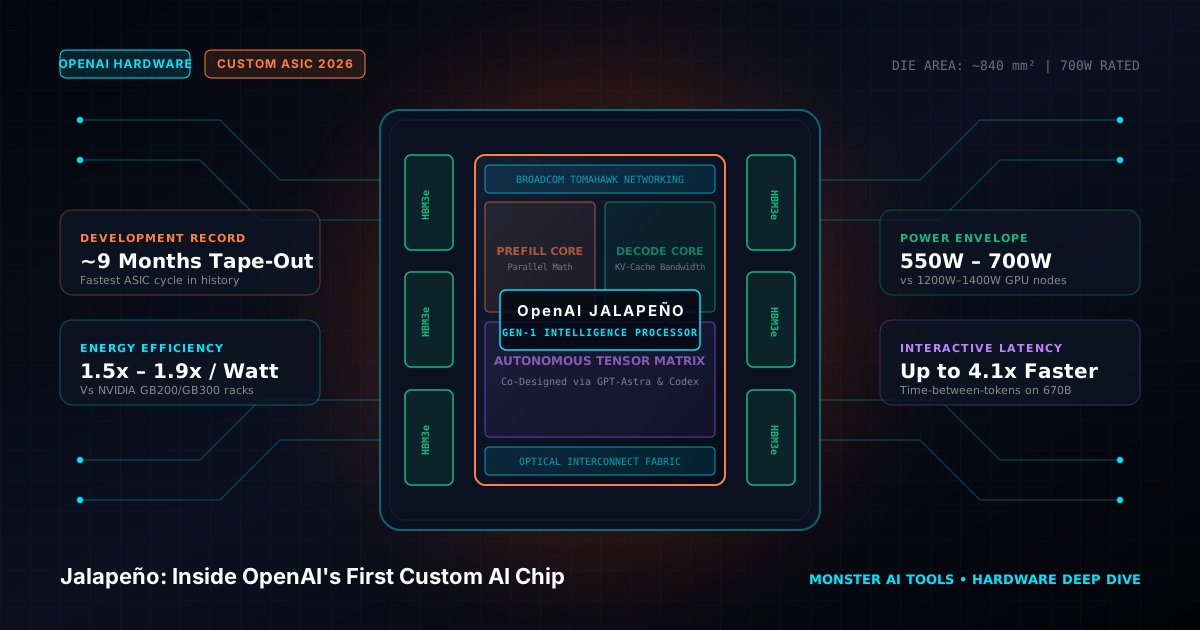
Jalapeño: Inside OpenAI's First Custom AI Chip
OpenAI and Broadcom have pulled the wrapper off Jalapeño — OpenAI's first purpose-built ASIC 'Intelligence Processor' for LLM inference. Here is how it was built in 9 months, how it solves the prefill/decode bottleneck, and its benchmark gains.

DeepSeek-R1 vs Claude 3.7 Sonnet vs OpenAI o3: The Ultimate 2026 Reasoning Benchmark
A comprehensive, technical breakdown of test-time compute, reasoning tokens, and coding benchmarks between DeepSeek-R1, Claude 3.7 Sonnet, and OpenAI o3.
AI Research Assistants: Perplexity and Beyond
An honest, hands-on look at ai research assistants, including the parts most reviews leave out.